Stay informed with expert insights on testosterone therapy, men's health, and performance optimization.

Most men think muscle loss is a later-in-life problem that they'll deal with in their 80s and beyond; however, it actually starts gradually in the 30s, decades before you notice anything. Age-related muscle loss follows a fairly predictable trajectory (the muscle loss with age chart below shows you how). Changing hormones are part of that trajectory as well. This is because testosterone decreases by about 1% per year from the 30s, and lower testosterone levels are sometimes associated with less muscle; however, testosterone isn't the only reason for a decline in muscle strength (Shigehara et al., 2022).
The good news is that this trajectory isn't definitive; strength training and diet can make a big difference.
The loss of strength and muscle mass that occurs in aging is called sarcopenia. It's a slow erosion of the muscle developed in younger years, which results in muscle weakness. The European consensus, followed by clinicians, is to treat low muscle strength, not only low muscle size. This is because strength is a better indicator of real-world function than muscle mass (Cruz-Jentoft et al., 2019). The European Working Group on Sarcopenia in Older People (EWGSOP2)(Cruz-Jentoft et al., 2019) updated consensus uses low muscle strength as the primary parameter to identify sarcopenia, with diagnosis confirmed by low muscle quantity/quality.
Sarcopenia is common and affects a significant portion of adults over the age of 60, and the risk escalates with each decade thereafter (Cruz-Jentoft et al., 2019).
This is the typical pattern researchers have seen in studies regarding typical muscle mass and strength changes (Cruz-Jentoft & Sayer, 2019; Mitchell et al., 2012). The figures are ranges; they're not set in stone because activity level, physical health, and a healthy diet can alter the numbers.
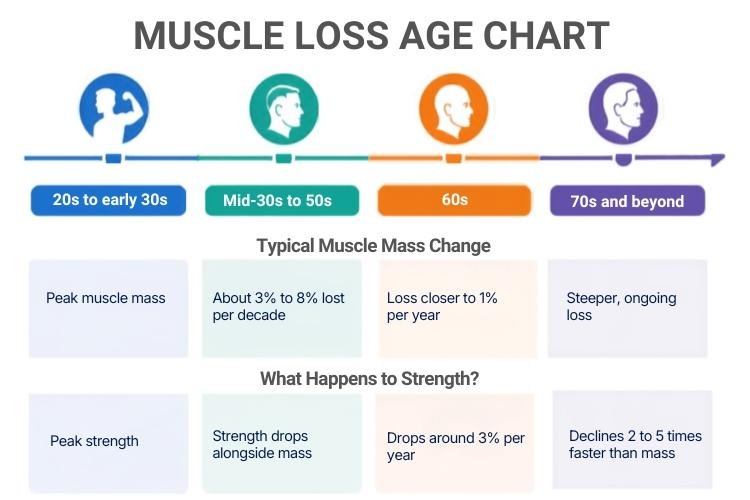
As is evident in this chart, after the age of 30, muscle mass decreases by approximately 3% to 8% per decade, and the rate increases after age 60 (Cruz-Jentoft & Sayer, 2019).
What surprises most men is the decline in strength too. Population-based studies over time have shown that strength is lost two to five times faster than muscle size. Furthermore, researchers have found that after the age of 75, leg strength can decrease by 3% to 4% a year (Larsson et al., 2019). In other words, your muscles don't just get smaller; they also get weaker per pound of tissue, which is what researchers call declining muscle quality (Larsson et al., 2019).
Several things happen as you age that contribute to muscle loss. Firstly, the nerves responsible for switching muscle fibers on begin to degenerate, causing some fibers to "switch off." Those fibers then waste away in a process known as muscle atrophy.
The rapid-response muscle fibers you rely on for quick bursts of power shrink the most, which is why muscle function and explosive strength fade early. The body also develops anabolic resistance, which is when it becomes less efficient at converting protein into new muscle (Kristiansen, 2026).
Hormones are important in this process as well because testosterone declines by approximately 1% per year from the 30s, and men who have lower levels generally have less strength and muscle mass (Shigehara et al., 2022).
Although this decline in testosterone is real, research teams have not shown that testosterone decline alone drives muscle loss (Shigehara et al., 2022). However, if both your drive and strength have dipped together, it's worthwhile looking into the symptoms of low testosterone.
Inactivity also promotes muscle atrophy, as the body stops maintaining unused tissue and skeletal muscle mass begins to decline.

Losing muscle isn't just about aesthetics; muscle weakness can make everyday tasks harder, whether it's getting up off the floor or carrying groceries and washing. Low muscle strength also increases the risk of falls and physical restrictions that can take away your independence later in life, and is linked to a greater risk of earlier death (Cruz-Jentoft et al., 2019; Xu et al., 2021).
A large portion of the sugar in your blood is stored and burned in the muscles; therefore, protecting your muscle health also supports your metabolism. The earlier you act, the more muscle you'll have to keep.
While aging is the main catalyst, other factors can substantially accelerate muscle mass loss and function:
The decline that we've seen in the chart above can be interrupted, and even reversed, even in your 70s and 80s, via two methods:
The most effective way to rebuild muscle and strength in older men is to lift weights with resistance and then slowly add load.
A 2023 study found that resistance training, especially when paired with good nutrition and balance work, resulted in the best gains in terms of physical function and strength for people with sarcopenia (Shen et al., 2023). Two or three sessions a week is sufficient; the goal is to rebuild muscle, not just slow the loss. If you're looking to build muscle after 60, progressive resistance training, sufficient protein, and adequate recovery are the main areas to focus on.
Older adults may need more protein than the standard recommended amount to maintain muscle mass. Research suggests that protein intake of approximately 1.0 to 1.2 grams per kilogram of body weight per day can help preserve lean body mass, in part because protein provides the amino acids muscles use to repair themselves (Ishaq, 2025). It's a good idea to try and include a protein source with each meal rather than loading it all into one dinner.
An active lifestyle helps too, as does getting adequate, good sleep and maintaining vitamin D levels. If you're considering vitamins for age-related muscle loss, it's important to understand where nutrients such as vitamin D fit alongside protein and resistance training.
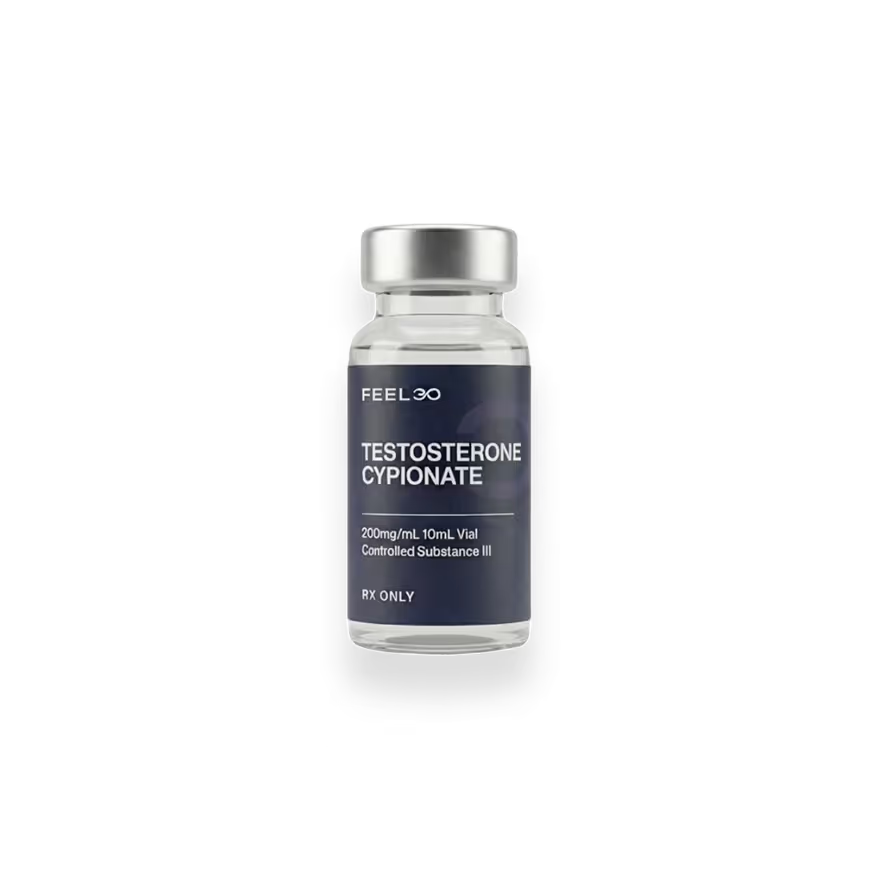
Supports energy, focus, sexual health, and overall wellbeing
Shop NowIt makes sense to wonder whether topping up testosterone could reverse age-related muscle loss, since testosterone helps build and maintain muscle; however, it isn't so simple.
Testosterone therapy may produce slight improvements in strength and muscle mass in some men, but the findings are inconsistent, and it isn't a typical treatment for muscle loss related to aging (Parahiba et al., 2020). The benefits of testosterone treatment are for men with genuinely low levels and not a quick fix for men whose levels are normal.
Testosterone replacement therapy (TRT) is for men who've been diagnosed with low testosterone that's been confirmed with bloodwork, and it should always be taken under the guidance of a licensed healthcare provider and continuously monitored.
If you've noticed a dip in your energy and strength, it's worth having a testosterone level test. You can check your levels with an at-home testosterone test and review the results with a healthcare provider. At Feel30, we offer provider-led TRT at home, with baseline testing and ongoing bloodwork, so treatment is based on actual numbers rather than symptoms alone.
Note: Testosterone therapy has side effects and isn't the right treatment for everyone. It should only be taken with a prescription and under supervision. If you'd like to know more, read our guide: Understanding Low Testosterone Symptoms.
A healthcare provider will do an examination, and you may also be asked to fill in a questionnaire based on your symptoms called the SARC-F test, which stands for:
Each of SARC-F's five components is scored between 0–2 (total 0–10). If your score is 4 or more, you may benefit from further testing (Cleveland Clinic, 2022).
Yes, you can. Older adults can build muscle and improve strength with progressive resistance training well into their 70s and 80s, and pairing it with sufficient protein can improve the results more (Ishaq, 2025).
Sarcopenia is a specific syndrome, related to age, that's characterized by the involuntary and progressive loss of muscle quality and mass (Papadopoulou, 2020).
Conversely, muscle atrophy is the thinning of muscle tissue due to injury, disuse, or nerve damage (for example, after bed rest or when your limb’s been in a cast), which can happen at any age and is usually reversible when activity resumes.
Creatine monohydrate along with high-quality protein (such as whey) may be helpful for older adults. Research suggests that combining resistance training with creatine may improve upper- or lower-body strength and muscle mass when compared to lifting weights alone (Li, 2026).
There's emerging clinical research highlighting a link between low strength/muscle mass and cognitive decline.
Studies have shown that lower grip strength and sarcopenia are connected to a risk of developing dementia and mild cognitive impairment, which is possibly due to their common underlying pathways, namely, inflammation, vascular dysfunction, and reduced physical activity (Peng et al., 2020).
Muscle and bone have an interdependent relationship; when muscle strength declines, the force placed on the bones during physical activity also declines, which speeds up the loss of bone density (osteoporosis).
When osteoporosis and sarcopenia occur simultaneously, it's known as osteosarcopenia, and it increases the risk of long-term disabilities, fractures, and loss of independence when compared to having only one of the conditions (Laskou et al., 2022).
Doing heavy-resistance exercise and getting enough vitamin D and protein is important because it stimulates bone remodeling and muscle fibers at the same time.
While the Muscle Loss With Age Chart shows a slow decline from around the age of 30, it's not something that's set in stone. The reality is that getting enough protein and doing strength training can slow down muscle loss and, sometimes, even reverse it, regardless of your age.
Similarly, a gradual drop in testosterone is part of the aging process, but clinically low testosterone is a separate issue that should be checked and confirmed by a healthcare provider and not self-treated. If low testosterone levels are affecting your muscle growth and energy, find a licensed provider to advise you on testosterone replacement therapy.
Take the first step toward renewed energy and confidence with Feel30’s expert care.



4.9 out of 5 · 2,400+ reviews


Always Tired, Gaining Weight? Low T Was the Real Reason
Is Low T Hurting Your Relationship?
This gaming laptop is a powerhouse, equipped with the latest graphics card and a high-refresh-rate display.
Jane Smith
Feel30 has completely changed the game for me. I feel more energized, focused, and confident like I did years ago.
Emily Johnson
This smartphone offers an exceptional camera experience, with stunning low-light performance and vibrant colors.
John Doe
What are you waiting for?
Take the first step toward renewed energy and confidence with Feel30’s expert care.


Feel 30 again with physician-supervised treatment that restores the energy, confidence, and performance you remember. No hassle or hidden fees.