Stay informed with expert insights on testosterone therapy, men's health, and performance optimization.
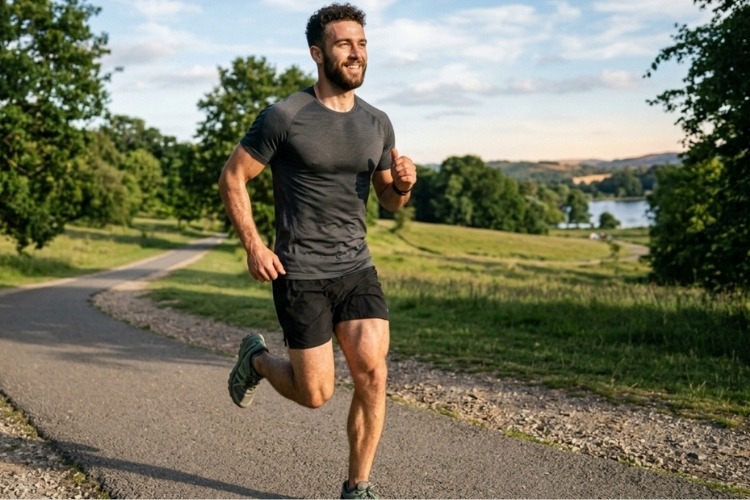
For many men, inactivity can accelerate the age-related decline in muscle strength. Research suggests that once you pass the mid-40s, muscle mass declines gradually across adulthood, with the rate of loss increasing in older adults (Tieland et al., 2018). The good thing, though, is that this decline is not fixed; with the right training program, you can build and maintain muscle at any age.
The best exercise program for men over 50 isn't usually a punitive bodybuilding regimen or hours of cardio; it's a plan built around heart-rate work and strength training, with mobility exercises to keep the joints healthy and support the hormones linked to drive and energy, including testosterone.
Your body doesn't suddenly change when you hit 50; however, the small changes that began in your 30s become more difficult to ignore.
Skeletal muscle decreases by about 3% to 8% every decade after 40, and it speeds up after 65 (Govindasamy et al., 2025). At the same time, strength declines even faster than muscle mass (Tieland et al., 2018). That's why catching yourself if you trip on the stairs or standing up after sitting on a low couch can feel different at 55 than at 40.
Hormones also play a role in your exercise plan. This is because testosterone, which declines slowly as you age, supports energy and muscle repair. You can't reverse the decline with an exercise regimen alone, but you can protect the muscle strength and function you already have. (If you'd like more information on the link between exercise and testosterone, read our guide: Does Exercise Increase Testosterone?)
The encouraging part is that muscle stays responsive to training well into later life. Doing resistance training is a reliable way to improve daily physical function and strength, even for men who are already showing signs of age-related muscle loss (Govindasamy et al., 2025). Essentially, training in your 50s just needs a bit more of a strategy than it did when you were 25.
The truth is, you need less than you might think. The World Health Organization (WHO) advises that adults get 150 to 300 minutes of moderate aerobic activity a week or 75 to 150 minutes of dynamic activity, as well as muscle-strengthening work on two or more days (Bull et al., 2020). The guidelines also advise incorporating activities that challenge your balance on three or more days a week.
When broken down, it's a manageable target:
Notably, you don't need two-hour marathon gym sessions. A simple, focused exercise routine like the one above will help you meet the physical activity guidelines with room to spare.
A good program for older men depends on four pillars: strength training, aerobic training, mobility and balance, and warm-ups and recovery. Each pillar has a different, but important, function, and leaving one out opens up a gap that can manifest as stiff joints or injuries.
Weight training is the single most worthwhile thing you can do after the age of 50, because it has a direct effect on muscle mass and strength (Izquierdo et al., 2021). These same resistance-training principles remain important if you want to build muscle after 60, although recovery and individual ability become increasingly important.
If you want to build muscle during this stage of life, it may be beneficial to focus on compound movements, in other words, the exercises that train both your upper and lower body, with various major muscle groups, at once:
Try to do two to three strength sessions per week and ensure you have the right form. Doing moderate reps helps build lean muscle and improve function (Izquierdo et al., 2021). To avoid injury, it's also best to rest for 24 to 48 hours before working on the same muscles again.
The most important principle is to gradually load: as the training starts to feel easier, add a rep or a little weight. Barbells, dumbbells, and resistance machines are all effective, so choose what you prefer, and if you're not sure about your form, it's worthwhile having a session or two with a personal trainer.
Doing cardio affects the invisible aspects of aging. An aerobic exercise routine can help keep blood pressure low, support your heart health, and help burn fat, especially stubborn belly fat that increases the risk of type 2 diabetes and heart disease. The WHO also lists better mental health and improved mood as benefits of cardio (Bull et al., 2020).
If you have knee issues, cycling, brisk walking, rowing, swimming, and the elliptical machine are all good alternatives. Your intensity should be in the moderate heart-rate zone, and a good way to test this is to see if you’re able to talk while exercising, but not sing. Adding shorter interval sessions in which you push hard for a minute and then ease off for two is a good way to efficiently improve fitness.
Mobility and balance are often overlooked, but can be just as essential as strength and aerobic training. Tight hips and stiff shoulders quietly limit how well you can squat or press, and poor balance increases the risk of falls.
This isn't a small concern; research shows that fitness programs that challenge balance help to reduce falls in older adults by approximately a quarter (Sherrington et al., 2019). That's why it's worth spending around five to ten minutes on movements that keep your joints healthy, such as:
If you find you have achy joints, you might benefit from reading our guide: Does TRT help with joint pain?
Recovery is crucial because muscle is actually built during rest, and not while you're training. For men over 50, recovery is even more important than it is in the 20s.
Warm up for five minutes before every session with light cardio and a few dynamic stretches so your joints are ready to load.
After exercising, protect your sleep, because sleep plays an important role in muscle repair. Also, it helps to stay hydrated throughout the day. Remember, the amount of time needed to recover will vary depending on your training intensity, type of exercise, and individual variations.
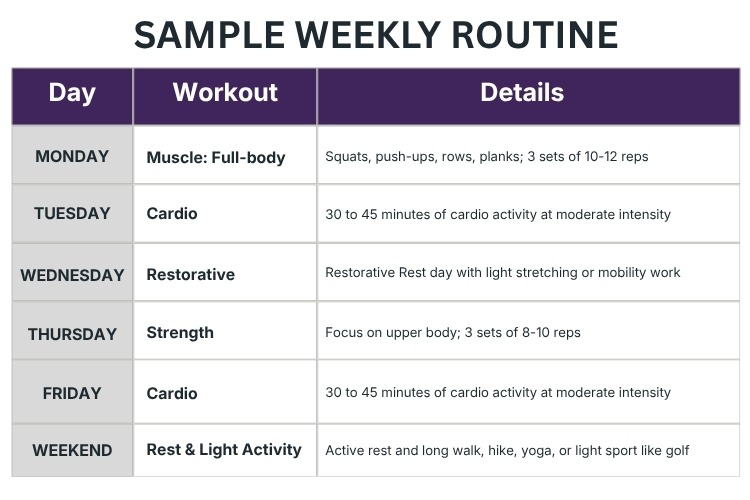
Here's how the four pillars of regular exercise fit into a realistic week, incorporating cardio, full-body strength, and mobility, and always a 5-minute warm-up..
Start lighter than you think you need to, especially in the first month, and add load slowly. If you're exercising again after years of inactivity, it's best to start with a lower volume and intensity and gradually increase as your strength and endurance improve. A few sessions with a personal trainer can help you get your form right before you start adding load.
Strength training challenges your muscles and signals them to adapt (get stronger). Getting enough protein and overall nutrition helps support muscle recovery and growth. The problem is that after 50, your body is less efficient at using protein, which is why the way you ate at 30 may no longer be good enough now (Deane et al., 2024).
Older men may benefit from eating more protein than the standard recommendation for adults. To get the benefits of your training and preserve muscle mass, some studies recommend at least 1.2 grams of protein per kilogram of body weight (Bauer et al., 2013). That equates to about 100 grams/day for a 180-pound man.
You don't need to take supplements; however, a simple protein powder may help you reach your goal on busy days. Good nutrition also supports natural hormone health, which also requires good eating and training habits. If you're interested in the link between testosterone and overall health, read our guide: How to raise testosterone.
Healthy eating habits such as these may make it easier to reach your goals:

Many men start training because they hope to improve testosterone without knowing exactly what exercise can and can't do. And while a session of both resistance training or aerobic exercise does cause a temporary increase in testosterone, it recedes within a few hours (Tu & Wang, 2026).
A meta-analysis of 22 studies done over weeks and months found that resistance training doesn't significantly change resting testosterone in older men, and interval and aerobic training revealed only a small positive effect (Hayes & Elliott, 2019). Although promising, current research doesn’t support exercise as a reliable treatment for hypogonadism (clinically low testosterone) even though it’s very important to maintain a healthy lifestyle.
In effect, exercise is beneficial for muscle mass and metabolism, but it's not a true fix for genuinely low levels of testosterone, which is a distinction that matters. If you're training regularly, getting good sleep, and eating well, but you still find that your energy is flat and you're not seeing results, it may be worth discussing it with a healthcare provider. These symptoms can have many possible causes, including but not limited to low testosterone. Understanding the broader benefits of testosterone can also help explain why healthy hormone levels matter for areas such as muscle mass, energy, sexual health, and overall well-being.
If you're concerned about your testosterone levels, learning more about understanding low testosterone symptoms can help you prepare for a discussion with a healthcare provider. An in-office or at-home testosterone test can provide further information for your healthcare provider to interpret alongside your symptoms and overall health.
Note: Low testosterone needs to be medically diagnosed through testing and under the guidance of a licensed healthcare provider, who'll confirm whether your symptoms are linked to testosterone or something else. If testosterone replacement therapy is needed, it should be specifically tailored to your needs and directed by a trained provider.
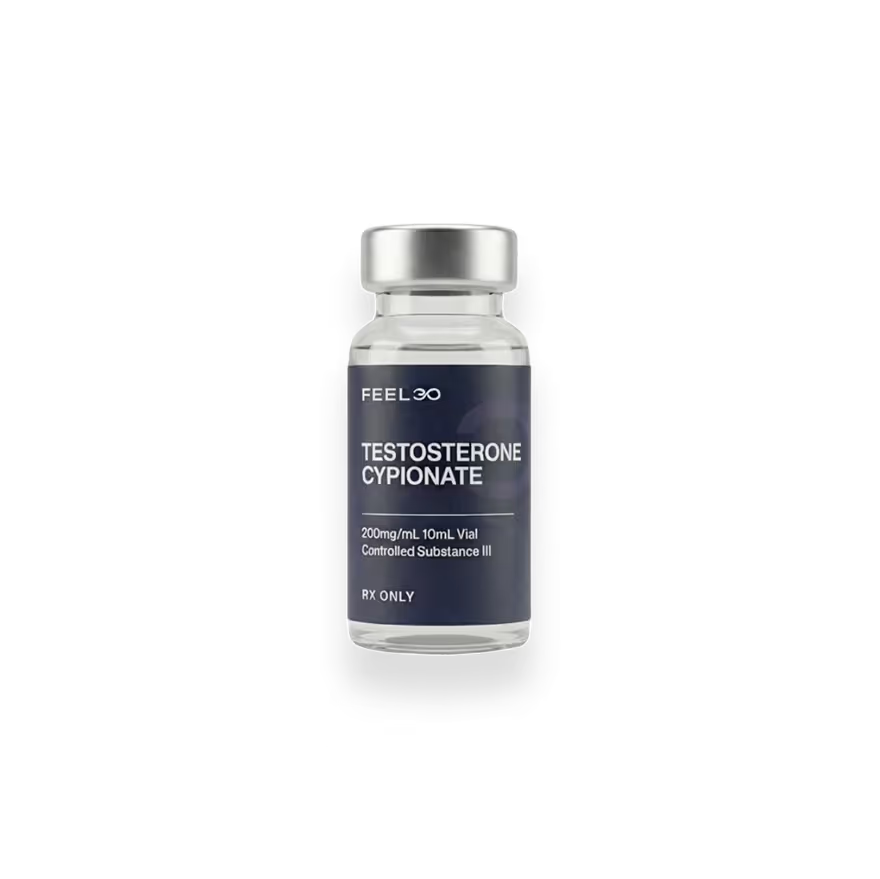
Supports energy, focus, sexual health, and overall wellbeing
Shop NowExercise is safe for most men over 50; in fact, the risks associated with being sedentary can be worse than the risks of training. That said, there are a few situations that require some caution. If you have uncontrolled high blood pressure, heart disease, diabetes, previous injuries, or any conditions that limit activity, you should consult a healthcare provider before starting a new program.
Injuries can happen when exercise intensity or training volume increases too quickly.
Some muscle fatigue and mild soreness can be normal when starting a new exercise routine. However, stop exercising and seek medical advice if you experience severe or worsening pain, chest pain, dizziness, fainting, or unusual shortness of breath (Bull et al., 2020).
Yes, you can. Even though muscle mass decreases as you age, muscles still respond to training, and you can improve physical function and strength after 50 (Govindasamy et al., 2025). The gains may take a little longer than in your 20s, and protein intake will need to be increased, but building muscle at 50, 60, and beyond is well within reach if you stay consistent.
Two to three strength training sessions per week is ideal and meets the muscle-strengthening guidance of a minimum of two days a week (Bull et al., 2020). This gives each muscle group enough incentive to grow and allows for 48 hours of recovery needed between hard sessions.
Both cardio and strength training have value. Strength training helps prevent age-related power and muscle loss; cardio does more for the waistline and heart health. A good program includes both, but if you're short on time, prioritize strength sessions (Izquierdo et al., 2021).
You may have more energy and improved mood within the first two to four weeks of starting an exercise program. Changes in strength can generally be noticed at around the six- to eight-week mark and changes in muscle size after about three to six months, but individual responses vary.
In effect, the best exercise program for men over 50 is a consistent one, made up of regular cardio, strength training a few times a week, mobility exercises, and sufficient protein to rebuild muscle, alongside recovery.
Exercise also supports natural hormone health, but current research doesn't support exercise to treat clinically low testosterone. If you've been exercising regularly but still feel flat, it's worth investigating it with a trained provider.
If you do have clinically low testosterone, Feel30 provides testosterone replacement therapy (TRT) at home, with the support of a licensed provider.
Take the first step toward renewed energy and confidence with Feel30’s expert care.



4.9 out of 5 · 2,400+ reviews


Always Tired, Gaining Weight? Low T Was the Real Reason
Is Low T Hurting Your Relationship?
This gaming laptop is a powerhouse, equipped with the latest graphics card and a high-refresh-rate display.
Jane Smith
Feel30 has completely changed the game for me. I feel more energized, focused, and confident like I did years ago.
Emily Johnson
This smartphone offers an exceptional camera experience, with stunning low-light performance and vibrant colors.
John Doe
What are you waiting for?
Take the first step toward renewed energy and confidence with Feel30’s expert care.


Feel 30 again with physician-supervised treatment that restores the energy, confidence, and performance you remember. No hassle or hidden fees.