

Stay informed with expert insights on testosterone therapy, men's health, and performance optimization.

Is sermorelin a smart way to stimulate growth hormone production, or just another overhyped peptide?
Healthcare providers often frame it as a “more natural” option than direct human growth hormone (HGH). This is because sermorelin works by signaling your pituitary gland to release more of your own growth hormone. Unlike direct HGH injections, it doesn't replace growth hormone.
That sounds promising, but it also raises real questions. Does it actually help? How safe is it? And who is it right for?
Here's what you need to know about sermorelin, what it’s used for, its safety, how it compares with HGH, TRT, and enclomiphene, and when a provider-guided evaluation makes sense.
Sermorelin is a synthetic peptide that mimics the growth hormone-releasing hormone, or GHRH, which is naturally made in the body.
A current compound summary by the National Center for Biotechnology Information (NCBI) (2026) explicitly states that "sermorelin acetate is a growth hormone-releasing hormone (GHRH) analogue that stimulates the pituitary gland to produce and secrete growth hormone".
In plain English, it acts like a signal your body already recognizes. That signal tells the pituitary gland to release growth hormone. Historically, it was used medically in children with certain growth hormone-related issues and in the diagnostic evaluation of pituitary growth hormone secretion.
Sermorelin is a signal, not the hormone itself.
“Growth hormone-releasing hormone” may sound technical, but the concept is actually pretty straightforward. GHRH is the signal your brain sends to the pituitary gland to trigger growth hormone production. Sermorelin mimics that signal.
That distinction matters.
Note: Your body doesn’t release growth hormone continuously. It does it in pulses, usually tied to sleep, recovery, and metabolic demand. Sermorelin works within that system. It encourages your body to produce growth hormone on its own timeline rather than overriding it.
That’s why healthcare providers often position it as a way to support your own body’s production, rather than replace it entirely.
Let’s clear up the common misconceptions:
Sermorelin is often talked about in the same breath as HGH, fat loss, and performance enhancement. That’s where confusion starts.
Some people report improvements in energy, sleep, lean body mass, and overall well-being. But those outcomes vary, and the clinical evidence on long-term anti-aging effects remains limited and debated.
So the takeaway is simple. Sermorelin may support certain outcomes, but it’s not a shortcut, and it’s not a guarantee. It works best when paired with a solid foundation of nutrition and exercise.
Historically, sermorelin didn’t start as a performance or optimization therapy.
It was originally FDA-approved for medical use in children. Specifically, it was used to treat growth failure linked to growth hormone deficiency and to test how well the pituitary gland could produce growth hormone.
Those approvals date back to the 1990s.
The commercial versions were discontinued in 2008. This wasn't because they were unsafe or they didn’t work. The FDA determined that "Sermorelin Acetate injections were not withdrawn from sale for reasons of safety or effectiveness" (Food and Drug Administration, 2013). They were simply taken off the market for business and commercial reasons.
Today, when people talk about sermorelin, they’re usually referring to something different. It’s now discussed in the context of adult hormone optimization rather than pediatric treatment.
Adult hormone optimization simply means working with a healthcare provider to improve how your hormones function over time to boost energy, support recovery, body composition, and overall well-being.
Currently, there’s no marketed FDA-approved brand available. So when it’s prescribed, it’s typically through compounded formulations under a licensed provider's guidance.
Expert Insight: A compounded formulation is a prescription customized specially for you. According to the FDA, drug compounding is "the process of combining, mixing, or altering ingredients to create a medication tailored to the needs of an individual patient" (U.S. Food and Drug Administration, 2022). Sermorelin therapy is available in this manner.
Now, let's look at how sermorelin works in finer detail.
Under normal physiology, the brain releases GHRH, the growth hormone-releasing hormone. The pituitary gland then responds by releasing the growth hormone. Growth hormone plays a role in processes tied to tissue repair, metabolism, and body composition.
Sermorelin is designed to mimic that natural signal. It imitates GHRH, binds to the receptor, and prompts the pituitary gland to release growth hormone through the body’s usual pathway.
People compare sermorelin to HGH because both affect growth hormone, but they do it in very different ways:
That distinction is one reason some providers and patients view sermorelin as a more physiologic option. But “more natural” is not the same thing as risk-free. Excess growth hormone signaling can still cause problems with edema, joint discomfort, glucose control, and cardiovascular strain if the protocol is poor or the patient is a poor fit.

The interest in sermorelin for growth hormone support comes down to its potential support in several areas:
These are the results people are looking for, and in some cases, they do show up.
Since sermorelin stimulates your body’s natural growth hormone release, and the growth hormone plays a role in sleep, recovery, and metabolism, some patients report improvements in those areas over time.
Some research actually supports this:
These outcomes are not guaranteed, and they're not universal. Your results depend on the bigger picture:
If those aren’t in place, sermorelin won’t compensate for them.
Sermorelin is often described as reasonably well-tolerated under medical supervision. However, safety depends on the patient, the dosing strategy, the product source, and whether a provider is actually monitoring what happens after you start.
Used correctly, sermorelin can be appropriate for some patients. Used incorrectly, it can create avoidable risks.
Most side effects are mild and manageable, especially under medical supervision. These include:
Medical follow-up matters. Monitoring may include blood or urine testing to track how your body is responding and to catch any unwanted effects early.
Some symptoms go beyond mild side effects and need prompt medical attention. These red flags include:
Stop sermorelin therapy and contact a healthcare provider promptly if you experience any of the above. These are not symptoms to ignore or push through. They are risks tied to excessive or poorly managed growth hormone signaling.
Expert Insight: Be cautious with sermorelin if you have poor blood sugar control, a history of cardiovascular issues, fluid retention, or complex hormone conditions. These factors increase your risks and require closer medical supervision.
All patients should avoid self-directed use. Even with a provider, some individuals are not candidates for therapy. These include people with:
Sermorelin and similar growth hormone–releasing agents are prohibited in sport. Even outside that context, the point is simple: if your medical picture is complex, this is not a DIY protocol.
Where the medication comes from matters just as much as whether you use it. Compounded medications are not regulated in the same way as standard FDA-approved drugs. That doesn’t make them unsafe, but it does mean quality depends on:
There’s a clear difference between a licensed, reputable compounding pharmacy and an unverified online seller. The smart standard is simple:
Now, let's briefly examine sermorelin versus other hormone-optimization options.
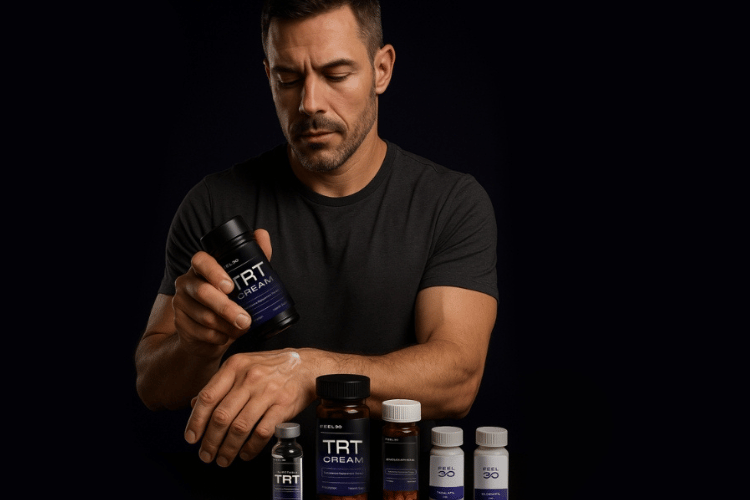
People often compare these options, but they solve different problems. The right choice depends on what you’re trying to improve: energy levels, recovery, body composition, libido, or long-term hormone balance.
The core difference in these two is that one signals, the other replaces.
That said, both sermorelin and HGH injections affect growth hormone levels, and both require proper medical supervision.
Sermorelin and testosterone replacement therapy operate on completely different hormone systems.
If your main concerns are:
Then, testing for low testosterone and verifying you are a candidate for TRT therapy is the next step.
In some cases, both systems are involved. That’s where a combined approach, such as sermorelin with testosterone cypionate, may be considered.
Sermorelin is typically administered via injection, often as part of a consistent nightly routine. For men who prefer a simpler routine when addressing testosterone levels, oral TRT can be more convenient.
Learn more about testosterone in our guide: Understanding Low Testosterone Symptoms
This is where the conversation becomes more strategic. Both sermorelin and enclomiphene are often discussed as ways to support the body’s own hormone production rather than replace it.
If you have low testosterone and your priority is:
Then enclomiphene may be the better fit.
Not every dip in performance is a peptide problem. Sometimes the issue is sleep debt, stress, alcohol, poor nutrition, overtraining, low testosterone, insulin resistance, or all of the above. A good evaluation sorts that out first.
A good workup should include symptom review, health history, appropriate labs, and a real discussion of goals, risks, and alternatives. It should also account for lifestyle factors that move the needle more than people like to admit:
Sermorelin signals the pituitary gland to release more of your own growth hormone. It doesn't supply human growth hormone directly. In adult hormone optimization settings, it's often discussed for sleep, recovery, body composition (including bone health, improved energy, fat metabolism), and support for overall vitality, though results vary.
The downsides include injection site reactions, headache, flushing, dizziness, nausea, edema, joint or nerve pain, and possible effects on glucose control. The bigger downside is using it without a proper evaluation or supervision.
They are both peptides (short chains of amino acids), but they act on different systems. Sermorelin is a growth hormone-releasing hormone analog that signals the pituitary gland. Ozempic is semaglutide, a GLP-1 receptor agonist used for diabetes and weight control and management. They are not interchangeable.
Sermorelin was historically FDA-approved in branded forms for specific pediatric and diagnostic uses. Those commercial products were discontinued in 2008. There's no currently branded, FDA-approved, commercial sermorelin product marketed in the U.S. This is why present-day access conversations usually involve compounded prescription products.
No. Sermorelin is not available over the counter and typically requires a prescription from a licensed healthcare provider as part of an individualized treatment plan. Purchasing from unverified online sources carries potential safety risks.
People with:
Not necessarily. Some people are interested in it for body composition support. Outcomes vary and depend on the full context, including diet, training, sleep, and metabolic health. Note that fluid retention can occur. This may affect scale weight even when body composition goals differ from simple weight change.
Cost varies widely based on provider model, formulation, pharmacy, monitoring, and treatment duration. Because current access often involves compounded prescription products rather than a standard branded commercial drug, pricing is not standardized.
That question doesn't have a simple yes-or-no answer. Short-term tolerance may be acceptable in selected patients under supervision, but long-term adult outcome data are less definitive than marketing pages imply. That is one reason ongoing monitoring matters.
Some providers evaluate both pathways together because growth hormone signaling and androgen signaling affect different goals. That’s why providers may discuss a combined plan in some men, while others are better served by alternative treatments with TRT or enclomiphene alone.
Sermorelin is a synthetic growth hormone-releasing signal, not a direct HGH. That single distinction clears up a lot of confusion. It works upstream by telling the pituitary gland to release more of your own growth hormone, which is why it’s different from HGH therapy.
Is sermorelin safe? It can be tolerated under the right conditions, but safety depends on the patient, the protocol, the source, and the monitoring. That means the smartest move is a real medical review.
If you’re optimizing more than one pathway, Feel30 can help you assess whether sermorelin, testosterone cypionate, enclomiphene, oral TRT, or a combined plan makes sense for your goals, lifestyle, and risk profile.
Take the first step toward renewed energy and confidence with Feel30’s expert care.




4.9 out of 5 · 2,400+ reviews


Always Tired, Gaining Weight? Low T Was the Real Reason
Is Low T Hurting Your Relationship?
This gaming laptop is a powerhouse, equipped with the latest graphics card and a high-refresh-rate display.
Jane Smith
Feel30 has completely changed the game for me. I feel more energized, focused, and confident like I did years ago.
Emily Johnson
This smartphone offers an exceptional camera experience, with stunning low-light performance and vibrant colors.
John Doe
What are you waiting for?
Take the first step toward renewed energy and confidence with Feel30’s expert care.


Feel 30 again with physician-supervised treatment that restores the energy, confidence, and performance you remember. No hassle or hidden fees.
















%20Symptoms.webp)
